 登录
登录Bash Strict Mode: set -euo pipefail Explained
By default, a Bash script will keep running after a command fails, treat unset variables as empty strings, and hide errors inside pipelines. That is convenient for one-off commands in an interactive shell, but inside a script it is a recipe for silent corruption: a failed backup step that still reports success, an unset path that expands to rm -rf /, a curl | sh pipeline that swallows a 500 error.
Bash strict mode is a short set of flags you put at the top of a script to make the shell fail loudly instead. This guide explains each flag in set -euo pipefail, shows what it changes with real examples, and covers the cases where you need to turn it off.
The Strict Mode Line
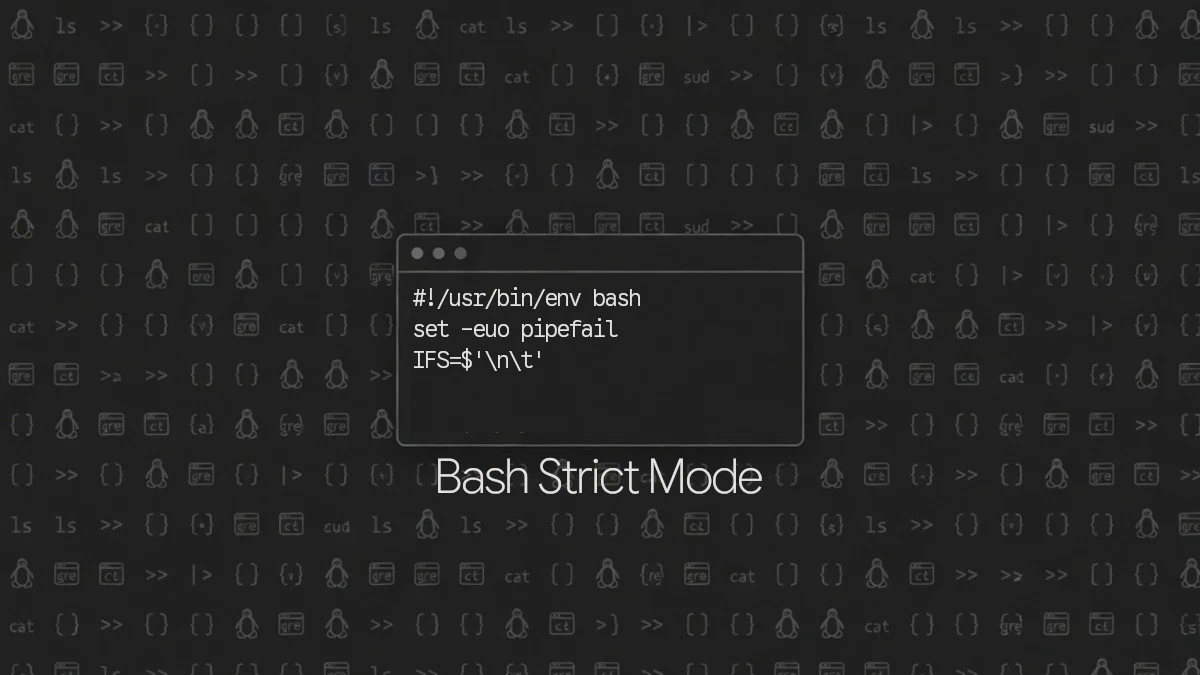
You will see this line at the top of many modern shell scripts:
#!/usr/bin/env bash
set -euo pipefail
IFS=$'\n\t'
Each flag addresses a different class of silent failure:
-
set -eexits immediately when a command returns a non-zero status. -
set -utreats references to unset variables as an error. -
set -o pipefailmakes a pipeline fail if any command in it fails, not just the last. -
IFS=$'\n\t'narrows word splitting so unquoted expansions do not split on spaces.
You can enable the options separately, but in practice they are almost always used together.
set -e: Exit on Error
Without set -e, a failing command in a script does not stop execution. The script happily continues to the next line:
#!/usr/bin/env bash
cp /does/not/exist /tmp/dest
echo "Backup complete"
Running it prints both the error and the success message:
./no-strict.shcp: cannot stat '/does/not/exist': No such file or directory
Backup completeThe script exits with status 0, so any caller thinks the backup worked. Adding set -e changes the behavior:
#!/usr/bin/env bash
set -e
cp /does/not/exist /tmp/dest
echo "Backup complete"./strict.sh
echo $?cp: cannot stat '/does/not/exist': No such file or directory
1The script stops at the failing cp, never prints “Backup complete”, and exits with a non-zero status. Anyone scheduling this through cron or a CI pipeline now gets a real failure signal.
Opting Out for a Single Command
Sometimes you expect a command to fail and want to handle the result yourself. Append || true to tell set -e to ignore the exit status of that one command:
grep "pattern" config.txt || trueYou can also use if or &&, which set -e treats as deliberate checks:
if ! grep -q "pattern" config.txt; then
 echo "pattern missing"
fi
This is the canonical way to check for something without exiting the script when it is not there.
set -u: Fail on Unset Variables
A classic shell footgun is a typo in a variable name. Without strict mode, Bash silently expands the misspelled variable to an empty string:
#!/usr/bin/env bash
TARGET_DIR="/var/backups"
rm -rf "$TARGE_DIR/old"
The script deletes /old because $TARGE_DIR is empty. With set -u, the same script exits before the rm runs:
#!/usr/bin/env bash
set -u
TARGET_DIR="/var/backups"
rm -rf "$TARGE_DIR/old"./unset-strict.sh: line 4: TARGE_DIR: unbound variableHandling Optional Variables
Environment variables that may or may not be set need a default to play nicely with set -u. The ${VAR:-default} syntax provides one without touching the original:
PORT="${PORT:-8080}"
echo "Listening on $PORT"
If $PORT is unset or empty, the script uses 8080. If it is set, the original value is kept.
set -o pipefail: Catch Failures Inside Pipelines
By default, the exit status of a pipeline is the exit status of the last command. Everything to the left can fail silently:
curl https://bad.example.com/data | tee data.txtIf curl fails with a 404, the pipeline still exits 0 because tee wrote its (empty) input successfully. With set -o pipefail, the pipeline adopts the first non-zero exit status from any command in it:
#!/usr/bin/env bash
set -o pipefail
curl https://bad.example.com/data | tee data.txt
echo "Exit: $?"curl: (6) Could not resolve host: bad.example.com
Exit: 6This is the one flag that fixes the most “my script said it succeeded but clearly did not” bugs, and it is the one most often forgotten when people add just set -e.
IFS: Safer Word Splitting
The Internal Field Separator (IFS) controls how Bash splits unquoted expansions into words. The default is space, tab, and newline, which means a filename with a space in it gets split into two arguments:
files="one two.txt three.txt"
for f in $files; do
 echo "$f"
doneone
two.txt
three.txtSetting IFS=$'\n\t' removes the space from the separator list. You still get clean splitting on newlines (useful for reading find or ls output) and on tabs (useful for TSV data), but spaces inside values are preserved.
Even with a narrower IFS, always quote your expansions ("$var", "${array[@]}"). IFS tightening is a safety net, not a replacement for quoting.
When Strict Mode Gets in the Way
Strict mode is opinionated, and a few situations push back. The most common one is reading a file line by line with a while loop and a counter:
count=0
while read -r line; do
 count=$((count + 1))
done < input.txt
That works fine, but if you increment with ((count++)) inside set -e, the script exits on the first iteration because ((count++)) returns the pre-increment value (0), which Bash treats as a failure. Use count=$((count + 1)) or ((count++)) || true to stay compatible.
Another common case is probing for a command:
if ! command -v jq >/dev/null; then
 echo "jq is not installed"
 exit 1
fi
Using command -v inside an if is safe even under set -e, because set -e does not trigger on commands in conditional contexts.
If you need to temporarily disable a flag for a specific block, turn it off and back on:
set +e
some_flaky_command
result=$?
set -e
This is cleaner than sprinkling || true everywhere when you have a block of commands that need softer error handling.
A Minimal Strict Script Template
Use this as a starting point for new scripts:
#!/usr/bin/env bash
set -euo pipefail
IFS=$'\n\t'

# Script body goes here.
It is four lines, and it catches the majority of silent failures that cause shell scripts to misbehave in production.
Quick Reference
| Flag | What it does |
|---|---|
set -e |
Exit when any command returns a non-zero status |
set -u |
Treat unset variables as an error |
set -o pipefail |
A pipeline fails if any command in it fails |
IFS=$'\n\t' |
Word-split only on newline and tab, not on spaces |
set +e / set +u
|
Turn the matching flag back off for a block |
command || true |
Ignore the exit status of a single command |
${VAR:-default} |
Provide a default for optional variables |
Troubleshooting
Script exits silently with no error message
A command is failing under set -e without printing anything. Run the script with bash -x script.sh to trace execution and see which line aborts.
unbound variable on a variable that sometimes is set
Replace the reference with ${VAR:-} to provide an empty default, or ${VAR:-fallback} to provide a meaningful one.
Pipeline fails on a command that is supposed to stop early
Commands like head can cause the producer to receive SIGPIPE, which pipefail treats as a failure. Either redesign the pipeline or wrap the producer in || true when the early exit is expected.
Strict mode breaks a sourced script
The set flags apply to the current shell. If you source a script that expects the old behavior, either fix the sourced script or wrap the source call between set +e and set -e.
FAQ
Should every Bash script use strict mode?
For scripts that run unattended (cron jobs, CI steps, deployment scripts), yes. For short interactive helpers, the flags are still useful, but the cost of a missed edge case is lower.
Does strict mode work in sh or dash?set -e and set -u are POSIX, so they work in any compliant shell. set -o pipefail is a Bash extension that also works in Zsh and Ksh, but not in pure POSIX sh or dash.
Is set -e really that unreliable?set -e has well-known edge cases, especially around functions and subshells. It is not a replacement for explicit error handling in critical paths, but combined with pipefail and -u it catches far more bugs than it causes.
How do I pass set -euo pipefail to a one-liner?
Use bash -euo pipefail -c 'your command' when invoking Bash from another program such as ssh or a Makefile.
Conclusion
set -euo pipefail and a tighter IFS catch many of the silent failures that make shell scripts hard to trust. Pair strict mode with clear error handling using Bash functions
and a proper shebang line
when you want scripts to fail early and predictably.