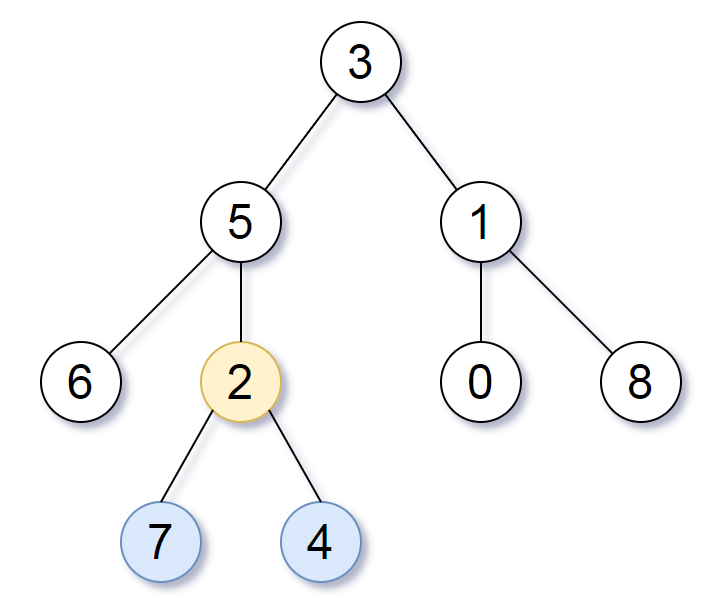
前置题目:236. 二叉树的最近公共祖先。
视频讲解:二叉树的最近公共祖先【基础算法精讲 12】。
方法一:递归递归,有递有归
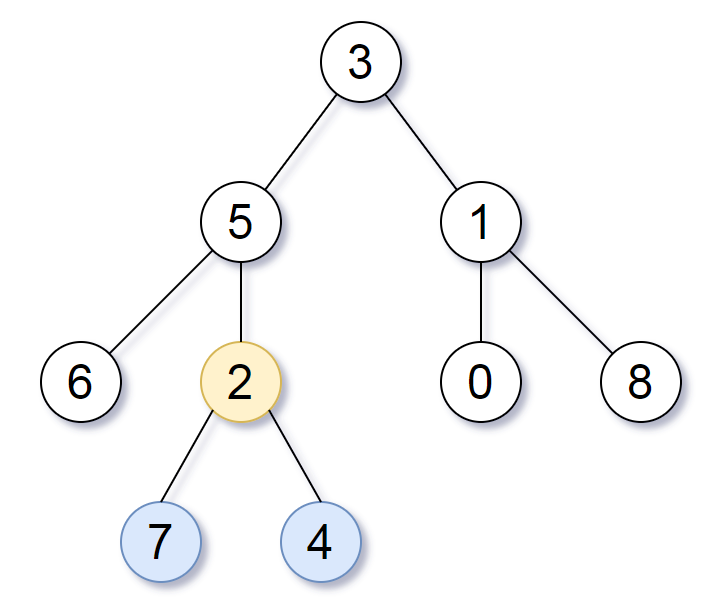 {:width=360px}
看上图(示例 1),这棵树的节点 $3,5,2$ 都是最深叶节点 $7,4$ 的公共祖先,但只有节点 $2$ 是最近的公共祖先。
上面视频中提到,如果我们要找的节点只在左子树中,那么最近公共祖先也必然只在左子树中。对于本题,如果左子树的最大深度比右子树的大,那么最深叶结点就只在左子树中,所以最近公共祖先也只在左子树中。
如果左右子树的最大深度一样呢?当前节点一定是最近公共祖先吗?
不一定。比如节点 $1$ 的左右子树最深叶节点 $0,8$ 的深度都是 $2$,但该深度并不是全局最大深度,所以节点 $1$ 并不能是答案。
根据以上讨论,正确做法如下:
- 递归这棵二叉树,同时维护全局最大深度 $\textit{maxDepth}$。
- 在「递」的时候往下传 $\textit{depth}$,用来表示当前节点的深度。
- 在「归」的时候往上传当前子树最深叶节点的深度。
- 设左子树最深叶节点的深度为 $\textit{leftMaxDepth}$,右子树最深叶节点的深度为 $\textit{rightMaxDepth}$。如果 $\textit{leftMaxDepth}=\textit{rightMaxDepth}=\textit{maxDepth}$,那么更新答案为当前节点。⚠注意:这并不代表我们立刻找到了答案,如果后面发现了更深的叶节点,答案还会更新。
class Solution:
    def subtreeWithAllDeepest(self, root: Optional[TreeNode]) -> Optional[TreeNode]:
        max_depth = -1  # 全局最大深度
        ans = None

        def dfs(node: Optional[TreeNode], depth: int) -> int:
            nonlocal ans, max_depth
            if node is None:
                max_depth = max(max_depth, depth)  # 维护全局最大深度
                return depth

            left_max_depth = dfs(node.left, depth + 1)  # 获取左子树最深叶节点的深度
            right_max_depth = dfs(node.right, depth + 1)  # 获取右子树最深叶节点的深度

            if left_max_depth == right_max_depth == max_depth:
                ans = node  # node 可能是答案

            return max(left_max_depth, right_max_depth)  # 当前子树最深叶节点的深度

        dfs(root, 0)
        return ans
class Solution {
    private int maxDepth = -1; // 全局最大深度
    private TreeNode ans;

    public TreeNode subtreeWithAllDeepest(TreeNode root) {
        dfs(root, 0);
        return ans;
    }

    private int dfs(TreeNode node, int depth) {
        if (node == null) {
            maxDepth = Math.max(maxDepth, depth); // 维护全局最大深度
            return depth;
        }

        int leftMaxDepth = dfs(node.left, depth + 1); // 获取左子树最深叶节点的深度
        int rightMaxDepth = dfs(node.right, depth + 1); // 获取右子树最深叶节点的深度

        if (leftMaxDepth == rightMaxDepth && leftMaxDepth == maxDepth) {
            ans = node; // node 可能是答案
        }

        return Math.max(leftMaxDepth, rightMaxDepth); // 当前子树最深叶节点的深度
    }
}
class Solution {
public:
    TreeNode* subtreeWithAllDeepest(TreeNode* root) {
        int max_depth = -1; // 全局最大深度
        TreeNode* ans;

        auto dfs = [&](this auto&& dfs, TreeNode* node, int depth) {
            if (node == nullptr) {
                max_depth = max(max_depth, depth); // 维护全局最大深度
                return depth;
            }

            int left_max_depth = dfs(node->left, depth + 1); // 获取左子树最深叶节点的深度
            int right_max_depth = dfs(node->right, depth + 1); // 获取右子树最深叶节点的深度

            if (left_max_depth == right_max_depth && left_max_depth == max_depth) {
                ans = node; // node 可能是答案
            }

            return max(left_max_depth, right_max_depth); // 当前子树最深叶节点的深度
        };

        dfs(root, 0);
        return ans;
    }
};
func subtreeWithAllDeepest(root *TreeNode) (ans *TreeNode) {
    maxDepth := -1 // 全局最大深度

    var dfs func(*TreeNode, int) int
    dfs = func(node *TreeNode, depth int) int {
        if node == nil {
            maxDepth = max(maxDepth, depth) // 维护全局最大深度
            return depth
        }

        leftMaxDepth := dfs(node.Left, depth+1) // 获取左子树最深叶节点的深度
        rightMaxDepth := dfs(node.Right, depth+1) // 获取右子树最深叶节点的深度

        if leftMaxDepth == rightMaxDepth && leftMaxDepth == maxDepth {
            ans = node // node 可能是答案
        }

        return max(leftMaxDepth, rightMaxDepth) // 当前子树最深叶节点的深度
    }

    dfs(root, 0)
    return
}
var subtreeWithAllDeepest = function(root) {
    let maxDepth = -1; // 全局最大深度
    let ans = null;

    function dfs(node, depth) {
        if (node === null) {
            maxDepth = Math.max(maxDepth, depth); // 维护全局最大深度
            return depth;
        }

        const leftMaxDepth = dfs(node.left, depth + 1); // 获取左子树最深叶节点的深度
        const rightMaxDepth = dfs(node.right, depth + 1); // 获取右子树最深叶节点的深度

        if (leftMaxDepth === rightMaxDepth && leftMaxDepth === maxDepth) {
            ans = node; // node 可能是答案
        }

        return Math.max(leftMaxDepth, rightMaxDepth); // 当前子树最深叶节点的深度
    }

    dfs(root, 0);
    return ans;
};
复杂度分析
- 时间复杂度:$\mathcal{O}(n)$。每个节点都会恰好访问一次。
- 空间复杂度:$\mathcal{O}(n)$。最坏情况下,二叉树是一条链,递归需要 $\mathcal{O}(n)$ 的栈空间。
方法二:自底向上
也可以不用全局变量,而是把每棵子树都看成是一个「子问题」,即对于每棵子树,我们需要知道:
- 这棵子树最深叶结点的深度。这里是指叶子在这棵子树内的深度,而不是在整棵二叉树的视角下的深度。相当于这棵子树的高度。
- 这棵子树的最深叶结点的最近公共祖先 $\textit{lca}$。
分类讨论:
- 设子树的根节点为 $\textit{node}$,$\textit{node}$ 的左子树的高度为 $\textit{leftHeight}$,$\textit{node}$ 的右子树的高度为 $\textit{rightHeight}$。
- 如果 $\textit{leftHeight} > \textit{rightHeight}$,那么子树的高度为 $\textit{leftHeight} + 1$,$\textit{lca}$ 是左子树的 $\textit{lca}$。
- 如果 $\textit{leftHeight} < \textit{rightHeight}$,那么子树的高度为 $\textit{rightHeight} + 1$,$\textit{lca}$ 是右子树的 $\textit{lca}$。
- 如果 $\textit{leftHeight} = \textit{rightHeight}$,那么子树的高度为 $\textit{leftHeight} + 1$,$\textit{lca}$ 就是 $\textit{node}$。反证法:如果 $\textit{lca}$ 在左子树中,那么 $\textit{lca}$ 不是右子树的最深叶结点的祖先,这不对;如果 $\textit{lca}$ 在右子树中,那么 $\textit{lca}$ 不是左子树的最深叶结点的祖先,这也不对;如果 $\textit{lca}$ 在 $\textit{node}$ 的上面,那就不符合「最近」的要求。所以 $\textit{lca}$ 只能是 $\textit{node}$。
class Solution:
    def subtreeWithAllDeepest(self, root: Optional[TreeNode]) -> Optional[TreeNode]:
        def dfs(node: Optional[TreeNode]) -> Tuple[int, Optional[TreeNode]]:
            if node is None:
                return 0, None

            left_height, left_lca = dfs(node.left)
            right_height, right_lca = dfs(node.right)

            if left_height > right_height:  # 左子树更高
                return left_height + 1, left_lca
            if left_height < right_height:  # 右子树更高
                return right_height + 1, right_lca
            return left_height + 1, node  # 一样高

        return dfs(root)[1]
class Solution {
    private record Pair(int height, TreeNode lca) {}

    public TreeNode subtreeWithAllDeepest(TreeNode root) {
        return dfs(root).lca;
    }

    private Pair dfs(TreeNode node) {
        if (node == null) {
            return new Pair(0, null);
        }

        Pair left = dfs(node.left);
        Pair right = dfs(node.right);

        if (left.height > right.height) { // 左子树更高
            return new Pair(left.height + 1, left.lca);
        }
        if (left.height < right.height) { // 右子树更高
            return new Pair(right.height + 1, right.lca);
        }
        return new Pair(left.height + 1, node); // 一样高
    }
}
class Solution {
    pair<int, TreeNode*> dfs(TreeNode* node) {
        if (node == nullptr) {
            return {0, nullptr};
        }

        auto [left_height, left_lca] = dfs(node->left);
        auto [right_height, right_lca] = dfs(node->right);

        if (left_height > right_height) { // 左子树更高
            return {left_height + 1, left_lca};
        }
        if (left_height < right_height) { // 右子树更高
            return {right_height + 1, right_lca};
        }
        return {left_height + 1, node}; // 一样高
    }

public:
    TreeNode* subtreeWithAllDeepest(TreeNode* root) {
        return dfs(root).second;
    }
};
func dfs(node *TreeNode) (int, *TreeNode) {
    if node == nil {
        return 0, nil
    }

    leftHeight, leftLCA := dfs(node.Left)
    rightHeight, rightLCA := dfs(node.Right)

    if leftHeight > rightHeight { // 左子树更高
        return leftHeight + 1, leftLCA
    }
    if leftHeight < rightHeight { // 右子树更高
        return rightHeight + 1, rightLCA
    }
    return leftHeight + 1, node // 一样高
}

func subtreeWithAllDeepest(root *TreeNode) *TreeNode {
    _, lca := dfs(root)
    return lca
}
function dfs(node) {
    if (node === null) {
        return [0, null];
    }

    const [leftHeight, leftLca] = dfs(node.left);
    const [rightHeight, rightLca] = dfs(node.right);

    if (leftHeight > rightHeight) { // 左子树更高
        return [leftHeight + 1, leftLca];
    }
    if (leftHeight < rightHeight) { // 右子树更高
        return [rightHeight + 1, rightLca];
    }
    return [leftHeight + 1, node]; // 一样高
}

var subtreeWithAllDeepest = function(root) {
    return dfs(root, 0)[1];
};
复杂度分析
- 时间复杂度:$\mathcal{O}(n)$。每个节点都会恰好访问一次。
- 空间复杂度:$\mathcal{O}(n)$。最坏情况下,二叉树是一条链,递归需要 $\mathcal{O}(n)$ 的栈空间。
分类题单
如何科学刷题?
- 滑动窗口与双指针(定长/不定长/单序列/双序列/三指针/分组循环)
- 二分算法(二分答案/最小化最大值/最大化最小值/第K小)
- 单调栈(基础/矩形面积/贡献法/最小字典序)
- 网格图(DFS/BFS/综合应用)
- 位运算(基础/性质/拆位/试填/恒等式/思维)
- 图论算法(DFS/BFS/拓扑排序/基环树/最短路/最小生成树/网络流)
- 动态规划(入门/背包/划分/状态机/区间/状压/数位/数据结构优化/树形/博弈/概率期望)
- 常用数据结构(前缀和/差分/栈/队列/堆/字典树/并查集/树状数组/线段树)
- 数学算法(数论/组合/概率期望/博弈/计算几何/随机算法)
- 贪心与思维(基本贪心策略/反悔/区间/字典序/数学/思维/脑筋急转弯/构造)
- 链表、树与回溯(前后指针/快慢指针/DFS/BFS/直径/LCA)
- 字符串(KMP/Z函数/Manacher/字符串哈希/AC自动机/后缀数组/子序列自动机)
我的题解精选(已分类)
欢迎关注 B站@灵茶山艾府

 登录
登录